Local SEO6 min read
Local Rank Tracking: How to Tell Whether Your Local Visibility Is Improving
Local rank tracking shows how visible a business is in local Google searches over time. It can help you answer practical questions: Does the business appear in Google Maps for important services? Are nearby competitors showing up more often? Did a profile update, new review, or website change affect visibility?
For a business serving a defined area, these answers matter. A ranking from one street can look very different from a ranking several miles away. That is why local rank tracking needs more care than checking a search result from your office computer and assuming the same view applies to every customer.
What does local rank tracking measure?
Local rank tracking records where a business appears for selected searches in a specific geographic location. Those searches may produce a local pack, Google Maps results, organic website listings, or a mixture of all three.
For example, a business might track searches such as:
- service name plus the local area
- service name near me
- specific service terms customers use when they need help
- brand name searches
- questions that often lead to a service enquiry
The useful part is the combination of keyword, location, date, and result type. A business ranking well for its name may still have weak visibility for the service searches that bring in new customers.
Why can rankings look different from one neighborhood to another?
Google can adjust local results based on where the search happens. A search made near the center of the service area may produce different results from one made near its edge. Distance, relevance, and prominence all influence what appears.
That creates a common source of confusion. An owner searches from the business address, sees a strong position, then hears from a customer in another part of the local area who could not find the business. Both experiences may be accurate.
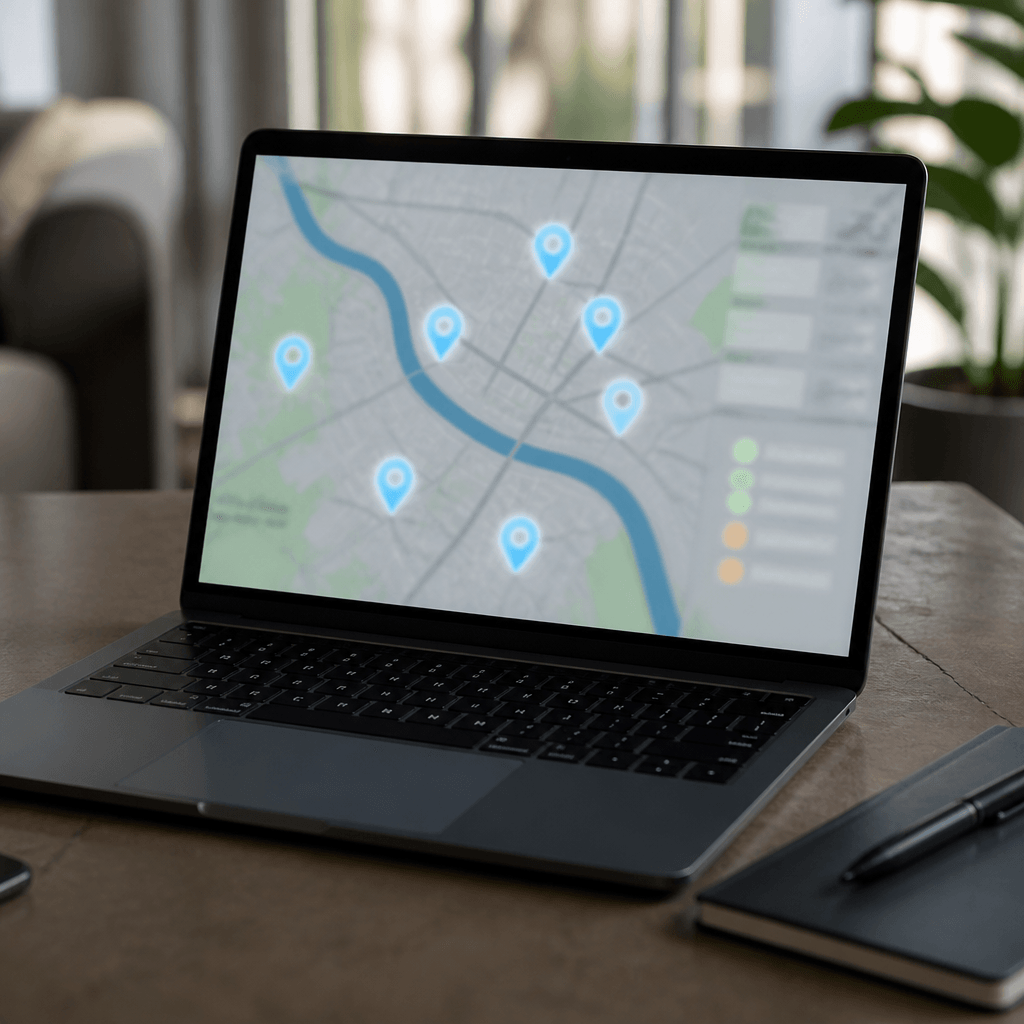
Good local rank tracking uses a grid of locations rather than a single point. The grid can include the business address, nearby neighborhoods, important service areas, and locations where enquiries commonly come from. This gives a more realistic view of visibility across the area.
Which searches should a local business track?
Start with searches connected to actual services and customer problems. Avoid building a huge list simply because a keyword has a high search volume. A smaller list of meaningful searches is easier to review and more useful for decisions.
A practical set may include:
- Core service searches: Track the main service terms a customer would use when ready to contact a business.
- Service and area searches: Include the local area, nearby towns, or neighborhood names that matter to the business.
- Urgent searches: For businesses that receive urgent enquiries, include terms that signal immediate need.
- Specific problem searches: Customers may search for a problem rather than a formal service name.
- Brand searches: These help confirm that the Google Business Profile and website are appearing for people who already know the business.
The best keyword list comes from real conversations, call records, website enquiries, and the wording customers use. A plumber, HVAC company, or auto repair shop may each need a different tracking list because customers describe their needs differently.
How often should rankings be checked?
Daily checking can create noise. Local results move for many reasons, including normal competition, search location, profile activity, reviews, and changes to Google results. A single drop does not always require an immediate change.
Weekly checks are often useful for active local marketing. Monthly reporting can be enough for a stable business, especially when the report also includes calls, website enquiries, direction requests, and profile interactions. The important point is consistency. Compare similar locations, search terms, and time periods so that trends are easier to spot.
After a significant profile update, website change, review pattern, or suspension issue, more frequent observation may help identify what changed. Keep a simple record of important actions and their dates. Without that record, it is easy to mistake coincidence for cause.
What should you do with ranking data?
Rank tracking is useful when it leads to a decision. A report that only shows positions gives an owner something to read, but not necessarily something to do.
Look for patterns such as:
- Strong brand visibility but weak service visibility: The profile may be easy to find for existing customers while new customers struggle to discover it.
- Good visibility near the address but weak reach farther away: The service area, website content, profile details, or local relevance may need review.
- One service improving while another stays flat: Different services may need clearer profile information and more focused website content.
- Several competitors appearing consistently: Review what they communicate clearly, including categories, services, photos, updates, and customer feedback.
- A sudden change across many locations: Check for profile edits, verification problems, suspension concerns, website issues, or changes in the search results.
Do not react to every movement. Look for a repeated pattern across several checks. Then connect that pattern with actions taken and business outcomes.
How do Google reviews fit into local rank tracking?
Reviews are part of the wider local visibility picture. Tracking only position can miss important changes in customer trust. A business may hold a similar ranking while receiving more calls because its recent reviews are more relevant, detailed, and reassuring.
Monitor review volume, recent activity, average rating, and the subjects customers mention. Service-related language can help a prospective customer understand what the business does, although reviews should never be written or shaped through misleading instructions.
Replying to reviews also gives a business an opportunity to acknowledge the customer and clarify the service provided. Keep replies specific and professional. Avoid copying the same response to every person.
What other numbers belong beside rankings?
Local rank tracking should sit beside measures that show whether visibility is producing useful action. Depending on the business, review:
- calls from the Google Business Profile
- website visits from local search
- contact form submissions
- requests for directions
- bookings or quote requests
- new reviews and review response activity
These numbers help separate visibility from business value. A ranking improvement for an irrelevant search may have little effect. A modest improvement for a high-intent service search may be much more meaningful.
Common local rank tracking mistakes
One mistake is relying on personal searches. Results can be influenced by location, device, search history, and other factors. Another is tracking too many phrases without grouping them by service and area.
It is also easy to compare different conditions. A result checked on a phone in one location should not be treated as directly comparable with a desktop result checked from another. Record the tracking setup and keep it consistent.
Finally, avoid treating a ranking position as a guarantee of enquiries. Visibility is one part of local SEO. The profile, landing page, service information, reviews, response process, and customer experience all affect what happens after the click or call.
How can a local business build a useful tracking routine?
Begin with a short list of priority services and locations. Record a baseline, then review the same searches on a regular schedule. Add notes about profile updates, new pages, review activity, and major business changes.
Each reporting period, identify one or two practical actions. That might mean clarifying a service description, improving a relevant page, responding to unanswered reviews, checking profile accuracy, or investigating a sudden visibility change. Small, documented adjustments are easier to evaluate than a long list of untracked changes.
GMB Done Right helps local businesses focus on Google Business Profile management, Google Business Profile optimization, Google Maps ranking, and local SEO services. For businesses in the local area, a clear rank tracking process can make marketing decisions less speculative and more connected to how nearby customers search.